
Integrations
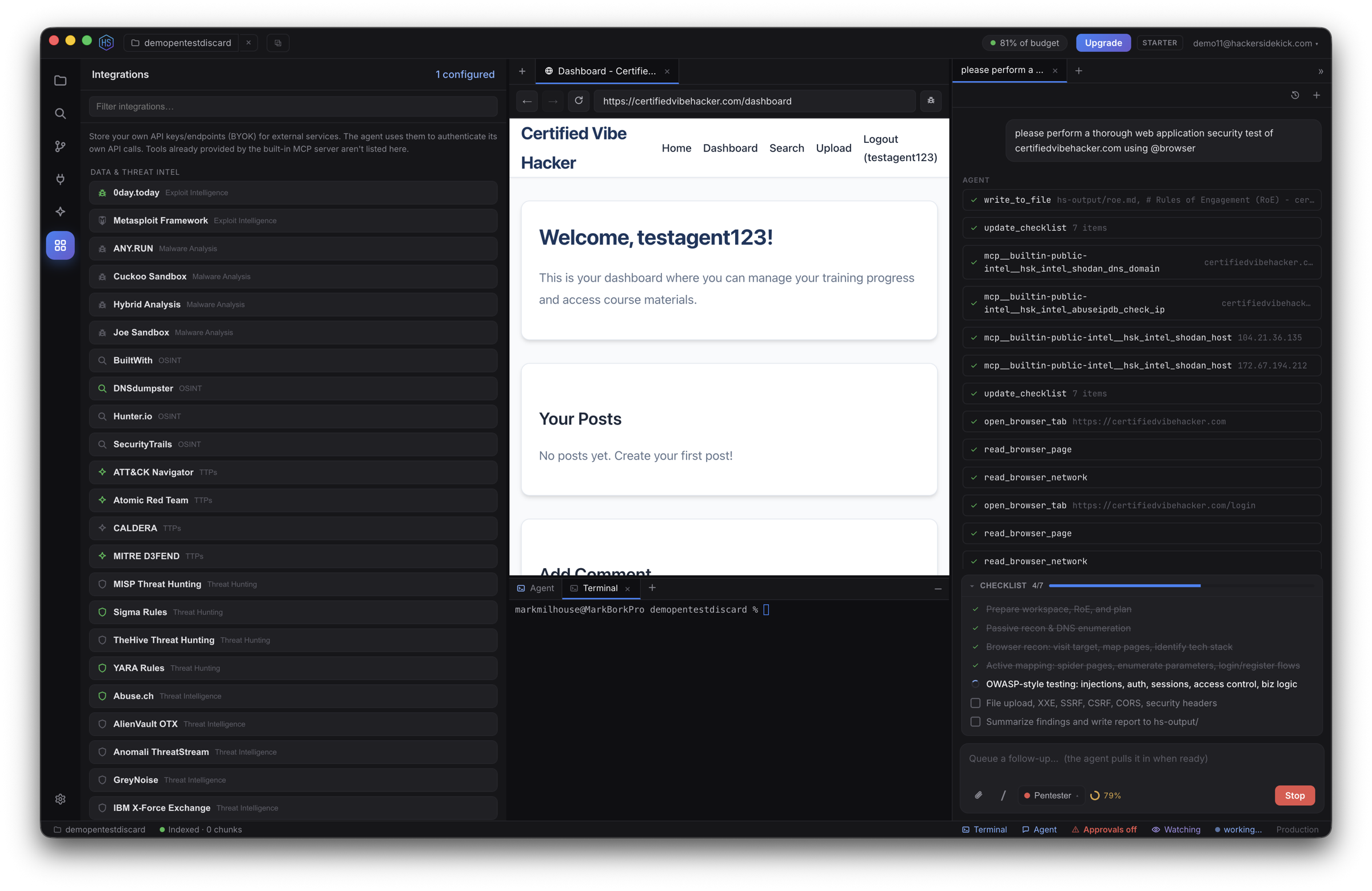
The Integrations view is a bring-your-own-key catalog of 58 security and workflow services you can connect, across:
- Data & Threat Intel — threat-intel feeds, OSINT and recon sources, malware sandboxes, adversary-emulation and defensive TTP libraries, and vulnerability intelligence.
- Internal / self-hosted tools — your own SIEM, log management, EDR, SOAR, and vulnerability-management platforms (Splunk, Elastic, CrowdStrike, Nessus, Wazuh, TheHive, OpenCTI, and more).
- Ticketing — Jira, GitHub, GitLab, Linear, ServiceNow, PagerDuty, Asana, Azure DevOps, Zendesk.
- Communication — Slack, Discord, Mattermost, Rocket.Chat.
How a connection works
Every integration is a direct connection. You supply the API URL and the exact credentials that service documents, and Hacker Sidekick opens its own TLS session straight to that URL. Nothing is relayed through us.
Credentials never reach the agent. They are held by the app and injected into each request in the background — the agent names an integration and a path, gets the response back, and never sees the key. It cannot ask for a credential, and it is explicitly prevented from calling these services itself with the terminal or scripts. Non-GET requests ask for your approval first.
What you'll be asked for
Each service asks for exactly what its API needs, so a two-part credential gets two boxes rather than one:
| Example | |
|---|---|
| API URL | Always present, pre-filled for hosted services (https://api.github.com) and blank for your own (https://splunk.internal:8089). Change it any time for a regional endpoint, a gov cloud, or an on-prem install. |
| A single key or token | GitHub, Slack, GreyNoise, Snyk |
| Two keys | Tenable (access key + secret key), Datadog (API key + application key), IBM X-Force (key + password) |
| Username and password | Qualys, ServiceNow, Wazuh, TAXII |
| Email and API token | Jira, Zendesk |
| ID, secret, and org key | Carbon Black Cloud |
| Client ID and secret | CrowdStrike, Microsoft Defender, Microsoft Sentinel — exchanged for a short-lived token automatically |
Self-hosted and certificates
Services you run yourself also accept TLS material, because private CAs and self-signed certificates are normal on-prem:
- a CA certificate to trust an internal issuer,
- a client certificate and key for mutual TLS,
- or, as a last resort, a skip verification toggle.
If a connection fails on the certificate, the error says which problem it hit and what to supply.
Test connection
Every integration has a Test connection button that runs a cheap, read-only probe with your saved credentials. It exercises the same URL, TLS, and authentication path a real call uses, so a green test means the agent's calls will authenticate too. A service saved with a credential still missing is marked incomplete and stays invisible to the agent until you finish it.
The full catalog
All 58 integrations, grouped the way the Integrations view groups them. Each is optional and off until you configure it — enable only what you use.
Data & Threat Intel
Threat Intelligence — AlienVault OTX · Anomali ThreatStream · GreyNoise · IBM X-Force Exchange · MalwareBazaar · PassiveTotal (RiskIQ) · Recorded Future · ThreatFox · URLhaus
OSINT — BuiltWith · DNSdumpster · Hunter.io · SecurityTrails
Malware Analysis — ANY.RUN · Hybrid Analysis
TTPs — CALDERA · MITRE D3FEND
Vulnerability Intelligence — Qualys VMDR · Rapid7 InsightVM · Snyk · Tenable Vulnerability Management
Vulnerability Management — Nessus
Internal / Self-hosted
SIEM Platforms — Elastic Security · IBM QRadar SIEM · LogRhythm SIEM · Microsoft Sentinel (Log Analytics) · Splunk · Sumo Logic
Log Management — Datadog · Graylog · Loki (Grafana Loki) · New Relic
EDR Platforms — Carbon Black Cloud · CrowdStrike Falcon · Microsoft Defender for Endpoint · SentinelOne
Vulnerability Management — Wazuh
Security Information Sharing — TAXII Server
Threat Intelligence Platforms — MISP · OpenCTI
Security Orchestration (SOAR) — Cortex XSOAR · Shuffle · Splunk SOAR (Phantom) · TheHive
Network Security — pfSense (requires the pfSense-pkg-RESTAPI package)
Ticketing
Asana · Azure DevOps · GitHub · GitLab · Jira · Linear · PagerDuty · ServiceNow · Zendesk
Interaction
Communication — Discord · Mattermost · Rocket.Chat · Slack
Also built in
Core threat-intel tools — MITRE ATT&CK, NVD/CVE, VirusTotal, Shodan, Censys, and Exploit-DB — ship ready to use through the built-in public-intel MCP server, so they need no key and aren't part of this bring-your-own-key catalog.
Working with the catalog
A few services are deliberately absent because they cannot be reached as a direct API connection: local tools and rule formats with no HTTP interface (Snort, Suricata, Zeek, YARA, Sigma, Atomic Red Team), and services whose authentication cannot be automated from stored credentials. If you need one of these, drive it from the terminal or connect it as an MCP server.
See also
- MCP servers — connect external tool servers
- Skills — packaged playbooks
- Approvals & safety